
Executive summary
Using Ookla coverage data, we measured indoor mobile coverage across 280 of Greater London’s most sought-after offices, all of them Grade A and Grade B. Fewer than one in ten deliver reliable indoor coverage, and nearly half have a problem serious enough that large parts of the building can’t hold a usable mobile signal.
The Grade A label makes no difference: those buildings are no better connected than Grade B, and occupiers are just as likely to end up walking to a window to take a call. If anything, the features that define a modern, high-quality building seem to count against it. Larger buildings tend to perform worse, as do those with higher energy ratings, and steel and concrete frames trail older masonry. Age offers no advantage either: offices completed in the last five years are no more reliable than ones built before 2000.
Occupiers feel the gap every time a call drops in a lift or a stairwell, and much of London’s premium stock sits on the wrong side of it.

Why indoor mobile coverage matters in commercial offices
Most of the mobile data we use is generated indoors. Industry estimates put the figure at around four-fifths, and inside an office that share is higher still. People expect to walk into a building and stay connected without thinking about it, and they notice quickly when they cannot.
Modern buildings are getting harder for a signal to reach. The coated, energyefficient glazing that keeps heat in also blocks much of the signal coming from the masts outside, and denser, better-sealed facades add to it. 5G has made this worse, not better, because the higher frequencies it runs on are weaker at getting through walls.
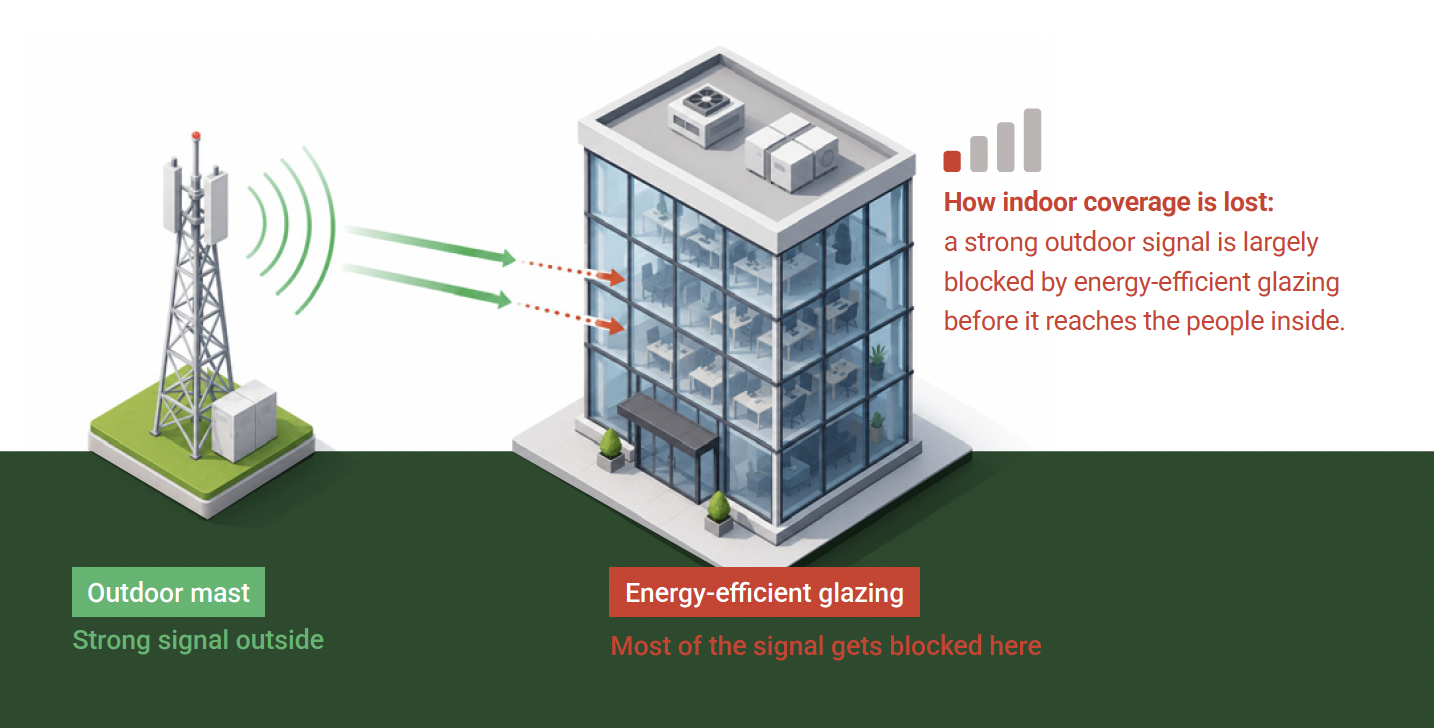
The outdoor signal buildings used to borrow from nearby masts is fading indoors just as people expect more of it. Older buildings often did better by chance, because their materials let more signal through. A new, sustainable, highly specified building can be one of the worst places in the city to take a phone call.
Very few commercial buildings have anything purpose-built to fix this. A widely cited estimate is that fewer than one in twenty has dedicated indoor mobile infrastructure. The rest depend on a signal that the building itself is increasingly designed to keep out.
The buildings we looked at and how we measure
The analysis covers 280 office buildings across Greater London, split fairly evenly between Grade A and Grade B. Every building is a sizeable commercial office, starting at around 50,000 square feet and running up past a million.

The sample spans the full range of the market. It includes buildings from before 2000 through to ones completed or refurbished in the last five years, energy ratings from unrated stock up to BREEAM Outstanding, and the main construction types found across the city. That spread is what lets us look at how coverage changes with each of these features, rather than reporting a single citywide average.
We used real-world signal readings taken inside each building during ordinary daily use, not a one-off survey, and combined them across the major operators. That reflects what a typical occupier actually experiences, rather than how one operator performs on a good day.
We don’t report the technical signal values, which mean little outside the industry. Every reading is sorted into one of three plain categories, a strong signal, a usable one, or a struggling one, and each building is judged on how much of it falls into each.
Across the whole sample, only 7% have reliable connectivity
9 in 10 of London’s most attractive offices have coverage they can’t count on

Across the whole sample only 7% are Reliable and 49% are Poor
Across the whole sample, only 7% are Reliable. Just under half, at 49%, are Poor. The remaining 44% are Patchy. Put another way, more than nine in ten of London’s most attractive offices have at least some indoor coverage they cannot count on. A building is rated Reliable when struggling readings are rare and a usable signal is available almost everywhere. It is Patchy when usable coverage is the norm, but noticeable dead spots appear. It is Poor when a large share of the building cannot hold a usable signal. Throughout this report, a building with a coverage problem means one that falls into the Poor category.
Reliable
A usable mobile signal almost everywhere inside. Dead spots are rare.
Patchy
Coverage works in places, but noticeable dead spots appear across the building.
Poor
Large parts of the building struggle to hold a usable signal. A real problem.