The legislation known as Martyn’s Law has been working its way towards force for some time, and the shape of it is now reasonably clear. The Terrorism (Protection of Premises) Act 2025 received Royal Assent on 3 April 2025, the Home Office published its statutory guidance on 15 April 2026, and the duties are expected to take effect in spring 2027 after an implementation period of at least 24 months. So there is a genuine window to prepare, though it helps to understand what preparing actually means, because the guidance is now detailed enough to plan against.
Who it applies to
The Act takes a tiered approach based on how many people might be present at once, staff included. Premises where 200 to 799 people may be present fall into the standard tier, and premises and events with 800 or more fall into the enhanced tier. The standard tier is built around simple, low-cost planning, while the enhanced tier asks for more, including documented procedures, a named senior individual and steps to reduce vulnerability.
The four public protection procedures
The heart of the law is a set of four public protection procedures: evacuation, invacuation, which means moving people to a safer place inside the building, lockdown, and communication. The first three usually get most of the planning attention because they are physical and easy to picture, whereas communication tends to be the one that gets written into the plan and then taken for granted on the assumption that it will work when it is needed. The guidance is fairly direct about it and expects a clear method for how staff alert one another and the people on site if an incident is suspected.
In the worked example the Home Office gives for a 400-seater restaurant, that comes down to staff knowing who gives the instruction and how they will reach customers if an attack happens. On a larger site the same procedure has to hold across several floors, back-of-house areas and exits, usually at the very moment when everyone present is trying to use their phone at once. That is also the point where most communication plans rest on an assumption nobody has actually tested, which is that people can get a signal wherever they happen to be standing.
Why indoor coverage is the weak point
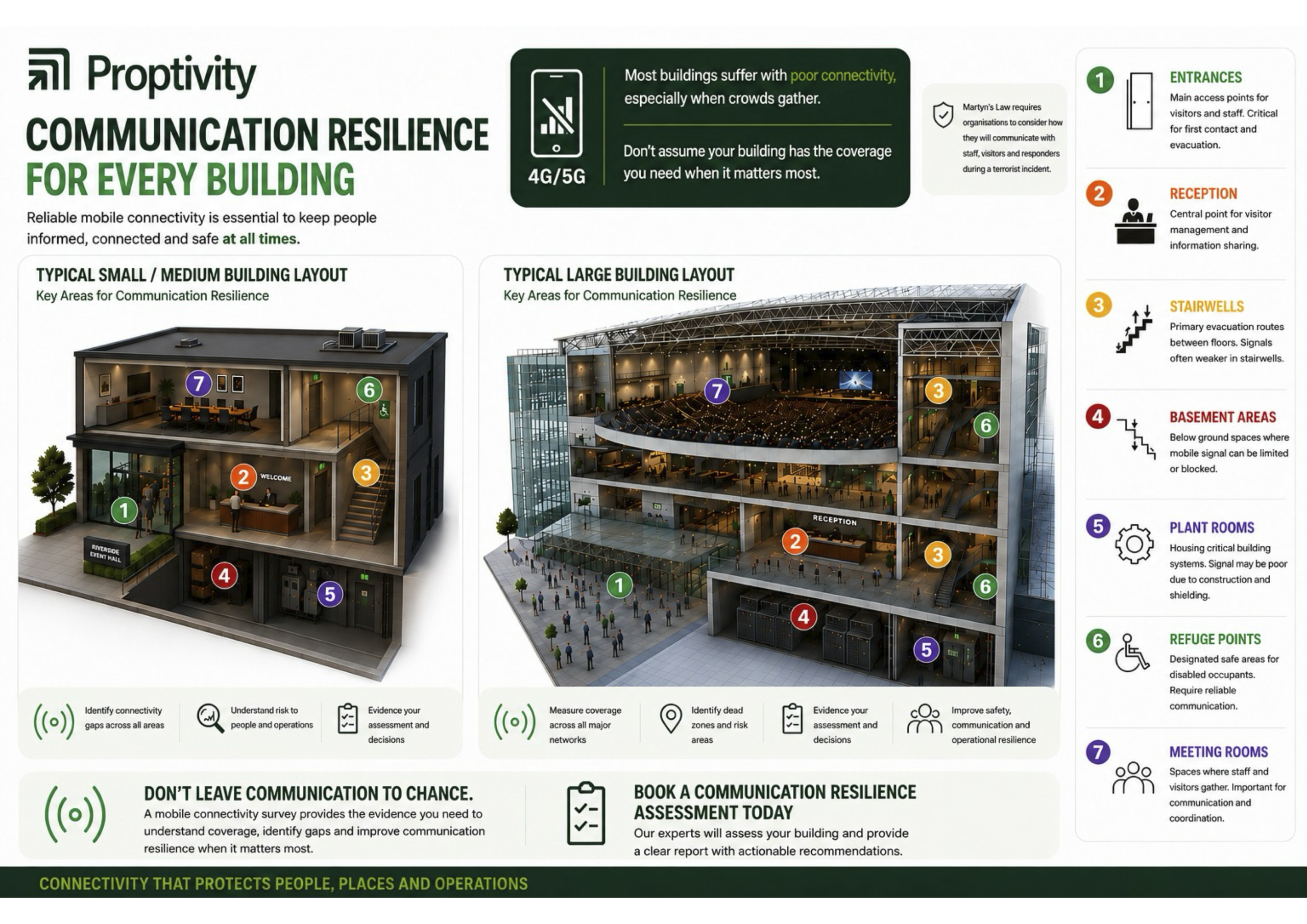
Mobile coverage inside a building is uneven even on an ordinary day, because thick walls, basements, lifts, stairwells and plant rooms all weaken or block a signal, and coverage that seems perfectly fine during a normal afternoon can drop away the moment a crowd arrives and everyone reaches for their phone together. The awkward part is that the areas with the worst coverage are often the ones that matter most during an incident. Stairwells are primary evacuation routes, basements and plant rooms sit below ground where signal struggles to reach, and refuge points exist precisely so that people who cannot easily evacuate, including disabled occupants, can wait in safety and stay in contact. If one of those areas is a dead zone, the procedure written on paper no longer matches the way the building actually behaves.
None of this means the law requires a particular level of mobile coverage. It does not, and the government has been explicit that organisations do not need to buy specialist products or hire consultants to comply. What the law does ask for is a communication procedure that works under real pressure, and there is no honest way to judge whether yours does without knowing where your building can and cannot carry a call or a message.
What you can do now
The implementation period is meant to be used as preparation time rather than treated as a reason to wait, and a reasonable first move is to find out where your coverage genuinely holds up. Walking the building and measuring signal across all the major operators shows you where coverage drops out, which replaces assumption with evidence and tells you whether your communication plan is standing on solid ground. Where there are gaps, there is plenty of room to act before 2027, whether that means understanding which areas need attention or putting shared indoor mobile infrastructure in place so that coverage stays reliable across the whole building and for every operator, including in the kind of crowded, high-pressure situation the law is concerned with.
Check your coverage
If you would rather not leave communication to chance, you can book a communication resilience assessment and we will measure coverage across your building and map the dead zones and risk areas, so you get a clear view of where you stand.
Reliable connectivity is what keeps people informed, connected and safe when it matters most, and Martyn’s Law is as good a reason as any to make sure your building can provide it.