
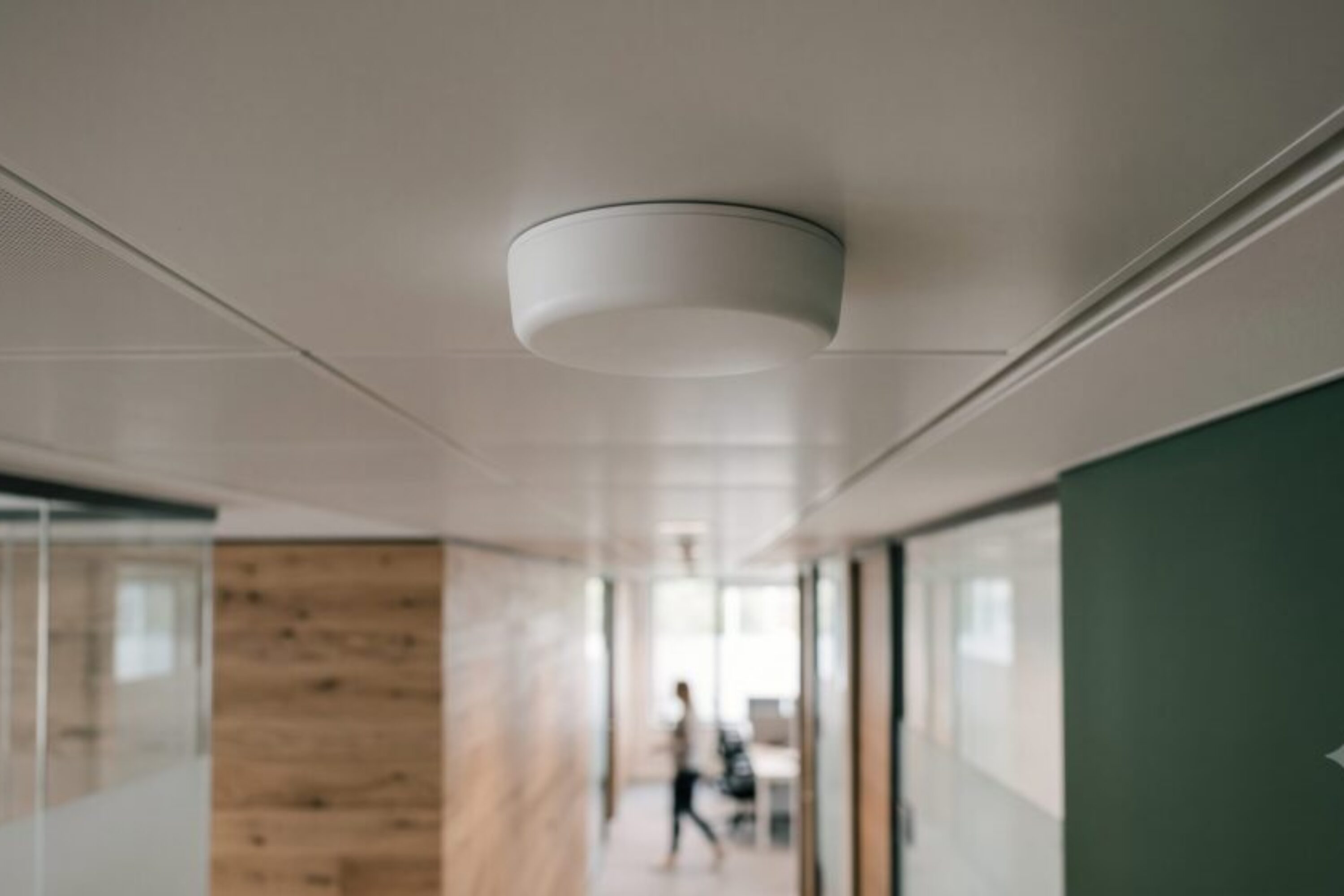
A mobile signal booster can fix poor coverage in an office when the space is small, the outdoor signal nearby is reasonably strong, and the main need is voice calls and light data. It cannot fix coverage in larger buildings or busy workplaces, because a booster only amplifies whatever signal exists outside: it adds no capacity of its own. Whether a booster is the right answer for your building therefore comes down to an honest assessment of what is actually failing, penetration or capacity. See article 1 in the series for the overview on indoor coverage challenge.
How a booster works
A booster, also called a repeater, uses an external antenna to capture the outdoor mobile signal, amplifies it, and re-broadcasts it inside through one or more internal antennas. Conceptually it drills a hole in the building’s radio insulation and pipes the street-level signal indoors. In the UK, boosters must comply with Ofcom’s licence-exempt specifications, and since a 2022 rule change compliant multi-operator repeaters are permitted, meaning a single properly specified unit can serve users on several networks.
For what it is, the technology is genuinely useful. A small professional office above a shop, a rural site cabin, a showroom with two or three staff: in these settings a compliant booster installed by a competent provider will noticeably improve calls and messaging for a modest one-off cost.
The three limits that matter
The first limit is dependency. A booster is entirely downstream of the outdoor network. If the nearest mast delivers a weak or congested signal, the booster reproduces that weakness indoors with perfect fidelity. At lunchtime, when the local cell is busy serving the street, the pavement and every other booster in the area, your amplified indoor signal is drawing on the same exhausted pool. Nothing about the building’s own demand is provisioned for.
The second limit is capacity. Amplification adds signal strength, not bandwidth. An office with two hundred people generates data demand that no re-broadcast street signal can serve, however strong the bars appear. Users experience the characteristic symptom of a capacity problem: a full signal indicator alongside crawling data speeds. This is the failure mode that confuses building managers most, because the booster appears to be working.
The third limit is coverage geometry. A booster serves the area its internal antennas can reach, which in practice is a floor or part of a floor. Extending one across a multi-storey building means cabling, additional antennas and diminishing returns, at which point the installation starts to resemble a poor version of purpose-built infrastructure without its benefits.
Booster or dedicated infrastructure: the honest comparison
|
|
Signal booster |
|
|
Signal source |
Amplified outdoor signal from the nearest masts |
Direct fibre connection to the operators; capacity dedicated to the building |
|
Capacity |
Limited to what the outdoor cell can spare; degrades at peak times |
Provisioned for the building’s own demand, consistent all day |
|
Coverage |
A floor or zone per unit; extending is awkward |
Building-wide by design, including cores, lifts and basements |
|
Operators served |
Compliant multi-operator units available |
All operators through one shared system |
|
5G support |
Partial; depends on outdoor bands reaching the antenna |
Full 4G and 5G, designed for future capability |
|
Monitoring |
Typically unmonitored; faults surface as complaints |
Monitored 24/7; issues resolved before tenants notice |
|
Best suited to |
Small offices, cabins, single-tenant spaces with decent outdoor signal |
Multi-tenant and larger commercial buildings where connectivity is expected to simply work |
The point of the comparison is not that boosters are bad and infrastructure is good, but that the tool has to match the failure. A booster addresses a penetration problem in a small space. Dedicated infrastructure addresses a capacity and coverage problem in a building where hundreds of people, and increasingly the building’s own systems, depend on mobile connectivity.
How to decide for your building
Most cases come down to three questions. First, how large is the space and how many people use it at peak? Below a few hundred square metres and a couple of dozen people, a booster deserves consideration; a multi-tenant office tower is beyond what amplification can serve. Second, is the outdoor signal near the building actually strong, on all the networks your occupiers use? If not, there is nothing worth amplifying. Third, does anything critical depend on the connection, payment terminals, alarm and safety systems, visitor connectivity, building services? If so, relying on the spare capacity of a street mast is a fragile foundation.
If the answers point beyond a booster, the alternative is infrastructure that brings 4G and 5G capacity inside the building through small cells and fibre, shared by all operators through a single system and agreement. That is the model Proptivity designs, installs and operates across commercial buildings in Europe.
Start with the data, not the hardware
Before choosing either path, it is worth knowing how your building performs today. Our free coverage check draws on real-world mobile measurement data for your location, and our team prepares a full indoor coverage assessment without cost or obligation. Deciding between a booster and proper infrastructure is much easier once the problem has a shape and a number.