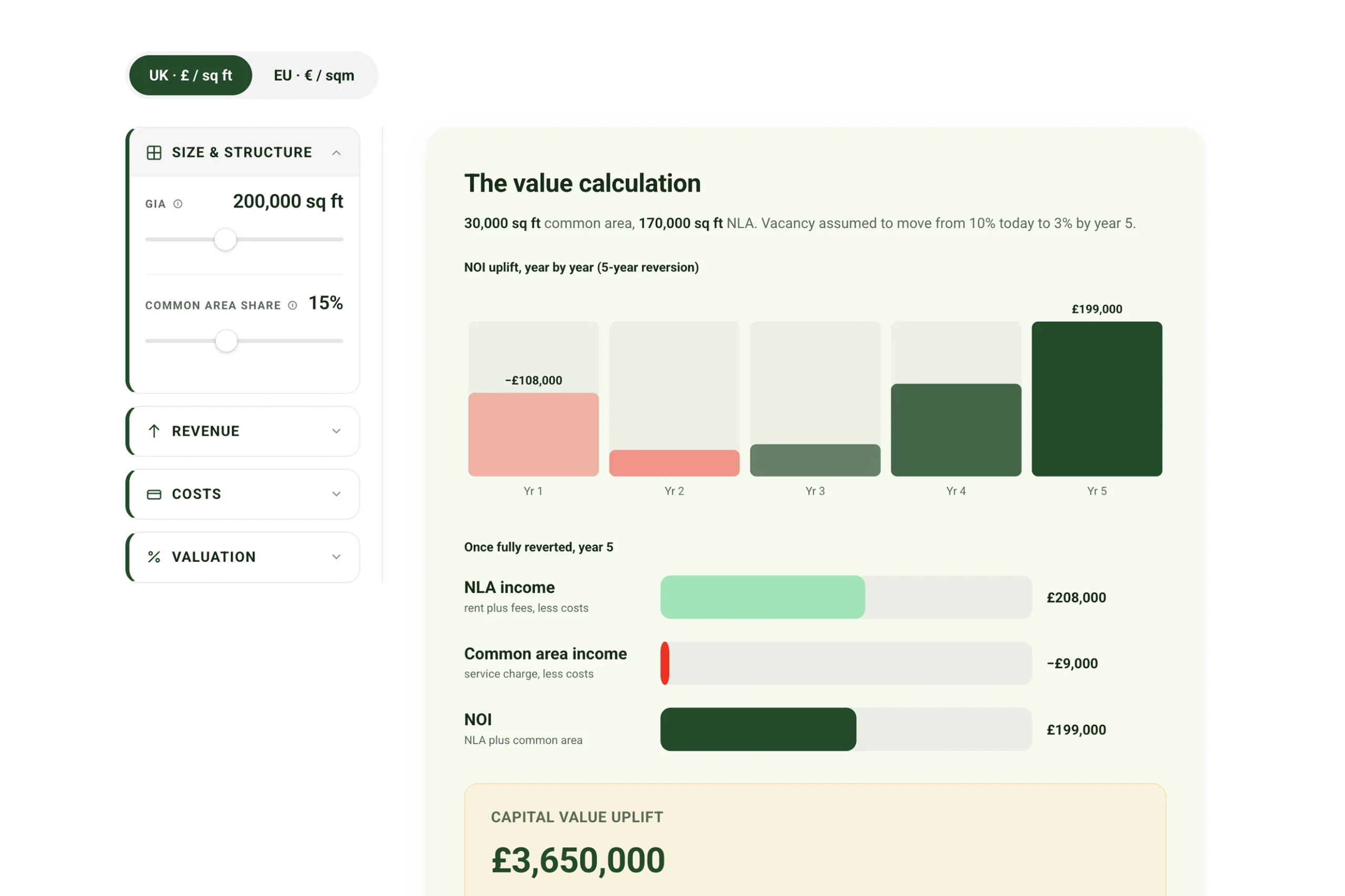
Set your building’s size, current rent and connectivity assumptions on the left. The calculator shows the rent increase, net income and capital value uplift they create, phased in realistically over time rather than assumed from day one.
Key terms
- GIA — Gross Internal Area: the total floor area of the building.
- NLA — Net Lettable Area: the area tenants actually pay rent on (GIA minus common areas like lobbies, corridors and plant).
- ERV — Estimated Rental Value: the current market rent for the space, before any connectivity premium.
- CapEx — Capital Expenditure: one-off costs, such as installing the connectivity system.
- OpEx — Operating Expenditure: the recurring annual cost of running and maintaining it.
- NOI — Net Operating Income: income minus operating costs — the standard industry measure of what a property actually earns.
Size & structure
- GIA — the total floor area to cover.
- Common area share — how much of the GIA is shared space (lobby, corridors, plant) rather than NLA.
Revenue
- ERV — the Grade A / new-build market rent, before any connectivity premium.
- Rental premium — defaults to WiredScore Platinum, the top-performing certification tier modelled in Cushman & Wakefield’s The Smart Premium (2025, data driven by WiredScore), based on 10 years of Central London office leasing data and WiredScore/SmartScore certification records. Actual premiums vary by building age, sector, location and occupier base, so it’s deliberately adjustable. The full premium applies once fully reverted, regardless of uptake rate.
- Reversion period — the number of years for the rent increase to fully revert to the new market rent. It isn’t captured from day one.
- Vacancy today / at year N — vacant space earns no rent increase, so the calculator moves vacancy linearly from today’s rate to the rate you expect once the reversion period ends.
- Connectivity fee — an optional separate per-sqm fee for connectivity in tenants’ own space, on top of the rent increase. Set to zero to rely on the rent increase alone.
- Uptake rate today / at year N — the share of tenants who actually pay the connectivity fee, which can grow the same way vacancy does — set higher at year N than today if you expect take-up to build as leases renew, or the same to keep it flat.
- Common area service charge — what tenants pay for common areas, set independently of the actual OpEx.
Costs
- CapEx (one-off) — the one-off capital cost of install. Defaults to zero for a coverage-as-a-service model.
- OpEx (per year) — the yearly operating cost of maintenance and managed service, separate from CapEx. A toggle next to it controls whether OpEx covers the whole floorplate or scales down to match the uptake rate.
Valuation
- Property yield — converts the net income increase into a capital value uplift (value = income ÷ yield). A lower yield produces a larger uplift.
About the numbers
Capital value uplift assumes the net income increase capitalises directly at the yield you set — a simplification a full appraisal would adjust for lease structure, covenant strength and market sentiment. All costs, fees, rents and yields shown are editable assumptions, not quotes, and the results are modelled estimates for illustration rather than a formal valuation or investment advice. For a building-specific assessment, request a detailed assessment below.


 United Kingdom
 Italy
Italy
 Norway
 Denmark
 Sweden